
The Neuroscience Case
For centuries, emotion and reason were treated as opposites — a tug-of-war between the heart and the head. Contemporary neuroscience has dismantled that idea. Emotion and reason are two sides of the same coin, woven together at every decision point.
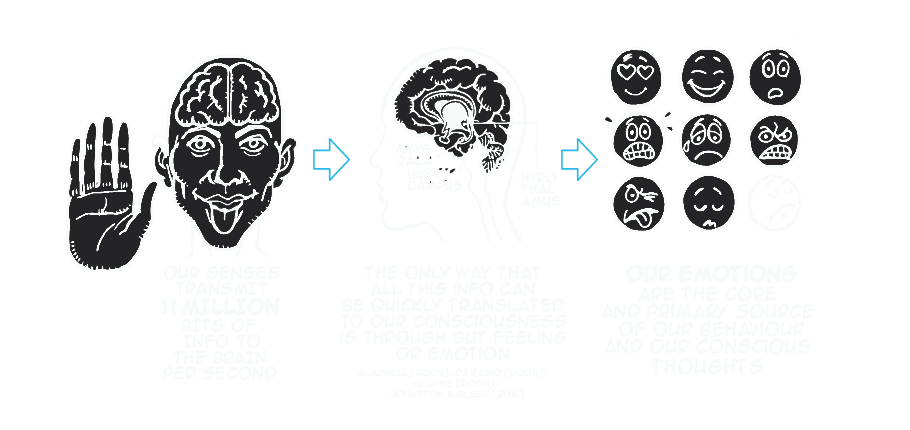
Your brain processes roughly a billion bits of information every second through non-conscious channels. Consciously, you can handle somewhere between 10 and 40 bits a second. The gap is enormous — and it is filled by what we call a feeling: a rapid, non-conscious verdict on a vast web of information the conscious mind could never process in time.
The Body Decides First
Neuroscientist Antonio Damasio demonstrated this with a simple card game, the Iowa Gambling Task. Players chose from four decks of cards, two riskier and two safer, with no upfront knowledge of the odds. Their bodies began registering stress responses around card 10 ,steering them toward the safer decks, but they could not consciously explain why until around card 80. The body knew, and acted, long before the mind caught up.
The Stories We Tell Ourselves
“We have, as human beings, a storytelling problem. We're a bit too quick to come up with explanations for things we don't really have an explanation for.” — Malcolm Gladwell
Studies of split-brain patients - people whose two brain hemispheres can no longer communicate - reveal something remarkable: when the body acts on information the conscious, speaking mind never received, that mind doesn't say "I don't know." It invents a perfectly plausible reason. Psychologists call this confabulation. It means that when you ask someone why they voted a certain way, trusted a certain brand or avoided a certain product, the answer they give you (however confident and detailed) may be a story told after the fact, not the actual cause.
This is precisely why traditional surveys, which rely on people explaining themselves, capture the storyteller rather than the story's true author. Qi Africa measures the signal beneath the story.
Feelings Are Contagious — Even at National Scale
“People are 'walking mood inductors', continuously influencing the moods and then the judgement and behaviors of others.” — Sigal Barsade, organisational psychologist
In one of the largest studies of its kind, researchers manipulated the emotional tone of content shown to nearly 700,000 Facebook users and found that emotion spread measurably from person to person, without a single face-to-face interaction. If feelings can move through a social network at that scale, they can move through a nation. Tracking that collective mood over time, and against real-world events, offers an early-warning signal that conventional indicators simply do not provide.